
Trinity County Criminal Court Cases
The Superior Court of California, County of Trinity handles the county's felony and misdemeanor prosecutions as well as traffic and infraction matters. There is no city court layer because Trinity County has no incorporated cities. Once a prosecutor files a complaint, information, or other charging document, the Superior Court assigns the case number and maintains the judicial file. That file records what was alleged in court, what happened at each hearing, and how each charge ended. It is distinct from a sheriff's incident report or jail booking file.
Court Services is the practical custodian for Trinity County criminal case records. The clerk can route questions about a case, court date, filing, public inspection, copies, and certification. The District Attorney presents prosecutions, but its office is not the public court-file archive. Likewise, the Marshal's Office handles court security and process functions, not criminal-history searches. Starting with the correct office avoids a common rural-county detour.
Trinity Criminal Records Stay Offline
The Trinity County District Attorney FAQ states that criminal records are not available online. That point matters. The court's online-services page lists useful tools, but it does not provide a general defendant-name or criminal-docket search. A reader should not expect a county portal to return all pending and closed prosecutions.
The online-services screen shows the limits clearly. It points to traffic and infraction functions, court calendars, and remote appearance information. Those services help after a person already knows the case or hearing. They do not replace a clerk inquiry. The source view of Trinity Superior Court online services shows the narrow set of tasks available remotely.
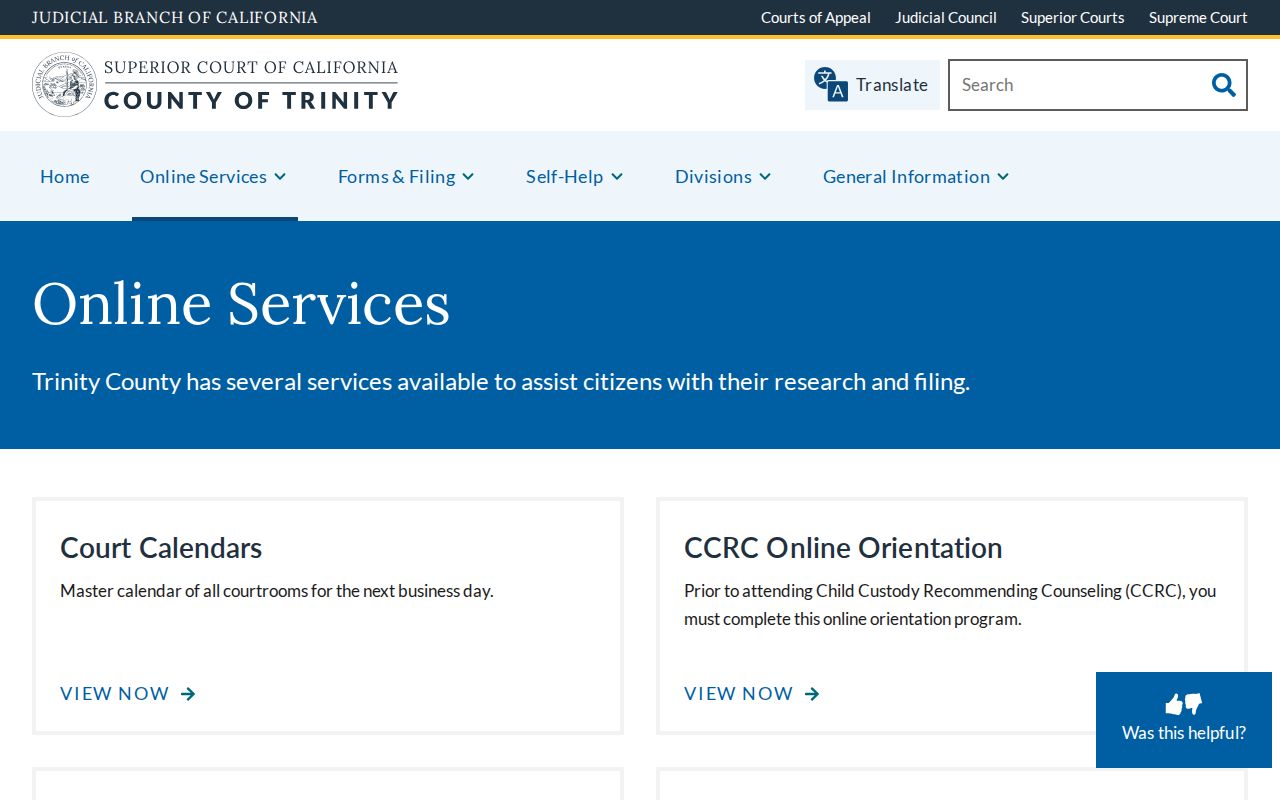
The captured page reinforces the right search path: use online tools for their named purpose, then contact Court Services for the actual Trinity County criminal court file.
Searching Trinity County Case Records
A Trinity County criminal case search is a clerk-channel request, not a web query. Gather enough detail to separate people with similar names. A case or citation number is best when known. A defendant name, approximate filing or arrest year, and date of birth may also help the clerk confirm identity. Then use the phone, counter, or mail channel that fits the request.
- Write down the defendant name and the case or citation number, if known. Add the approximate year and date of birth when needed to distinguish the record.
- Call Court Services at 530-623-1208 or visit 11 Court Street, Weaverville, during weekday counter hours from 8 a.m. to 4 p.m.
- Ask whether the matter is public, archived, sealed, juvenile, or limited to inspection at the courthouse.
- For a formal written request, mail Trinity Superior Court, Attn: Administration, PO Box 1258, Weaverville, CA 96093. Do not use the website contact form.
- Describe the exact items wanted and ask about copy or certification fees before ordering. An official Trinity copy-fee figure was not located in the research sources.
Trinity's only documented online case fields belong to ePay and MyCitations. They are included here so readers do not mistake those tools for a broad criminal search.
| Field Label | Type | Required | Notes |
|---|---|---|---|
| Citation or case number | Text | Yes | Used for ticket payment or financial-hardship requests, not a general criminal search. |
| Other identifying information | Text | Yes | Additional details connect the request to the right citation. |
| Ability-to-pay request | Online tool | Conditional | MyCitations supports eligible reduction, plan, time, or community-service requests. |
| Payment button | Link or button | No | The “Pay Fine Online” action handles eligible payments. |
Trinity Court Mail and Counter
In-person requests go to Court Services at the Trinity courthouse. The same location serves the Superior Court, clerk counter, and collections functions, but each has a different role. Ask the clerk for the register of actions when the goal is a dated list of filings and hearings. Ask for the disposition or judgment when the outcome matters most. Certified copies may be needed when an official copy, rather than an informational copy, is required.
Trinity Superior Court Services
11 Court Street
Weaverville, CA 96093
530-623-1208
Monday-Friday, 8 a.m.-4 p.m.
courtclerks@trinitycounty.org
Mail records requests to: Attn: Administration, PO Box 1258, Weaverville, CA 96093.
The court's forms and filing source organizes local forms, packets, fee schedules, and statewide forms used in Trinity County matters.
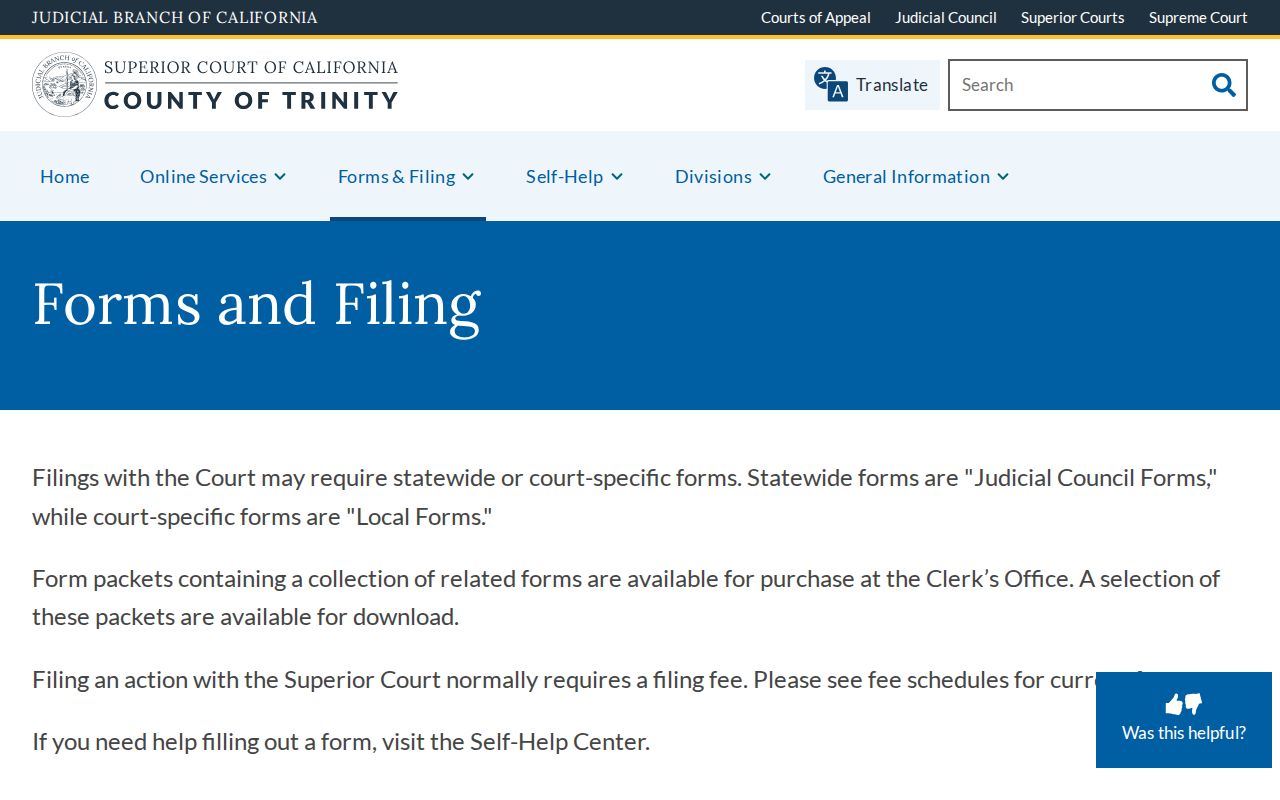
That forms screen is useful for filing preparation, but it is not an index of defendants or criminal cases. Court Services remains the record-access channel.
Inside a Trinity County Case File
A public Trinity County criminal case file can trace a prosecution from filing through its current or final result. The register of actions is often the fastest overview because it lists docket activity by date. The charging paper identifies the alleged offenses. Minutes and orders record what the judge did. A judgment and sentencing entry show the final court action when a conviction occurred. Not every field is open, and no public sample case was collected for the research.
| Case Number & Court | The identifier assigned after filing and the Trinity Superior Court division holding the matter. |
|---|---|
| Charging Document | The complaint, information, or other paper listing alleged offenses and statutes. |
| Docket Entries | The register of actions, filed documents, minutes, motions, and court orders by date. |
| Hearing Dates | Past and scheduled arraignments, pretrial hearings, trial settings, and other appearances. |
| Disposition & Judgment | The current or final result for each charge, including a plea, conviction, acquittal, or dismissal. |
| Sentence & Conditions | Custody, probation, fines, restitution, and other terms ordered after conviction, when public. |
The court file does not equal a California DOJ rap sheet. A rap sheet links fingerprint-based arrest cycles and reported outcomes across the state. It is available to the record subject through DOJ Record Review and to recipients authorized by law, not through a public name search.
Trinity Criminal Calendars and Hearings
A calendar answers a narrower question than a case file: when and where a matter is set. Trinity Superior Court publishes court calendar and remote appearance information, but the calendar should not be read as a full history or final outcome. Settings change, cases can be continued, and the clerk remains the source for court-date questions.
The official calendar source also addresses remote observation and warns that Zoom proceedings may not be recorded. The screenshot of Trinity County court calendars helps show the distinction between seeing a setting and obtaining the underlying record.
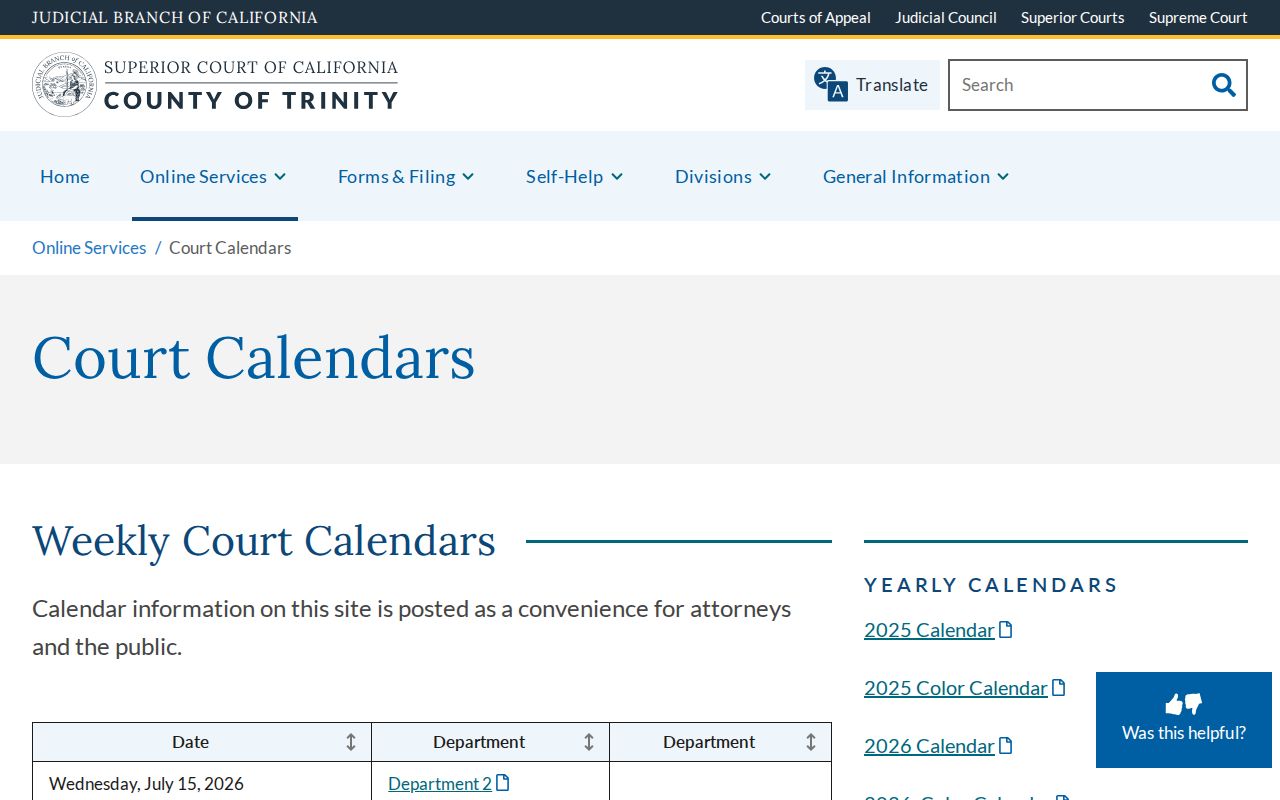
Use the calendar to confirm a listed event. Use the register of actions, minutes, or judgment to learn what occurred in the Trinity County criminal case.
How a Criminal Case Moves
A case file begins when charges are filed, not merely when an arrest occurs. At arraignment, the court states the charges and addresses the plea and rights. Pretrial entries may reflect motions, negotiations, discovery issues, and new dates. The matter then reaches a plea, trial, dismissal, or another disposition. If there is a conviction, the court enters judgment and imposes sentence. Trinity's criminal division states that appearances are generally required unless the court or counsel says otherwise.
Case flow: Charges Filed › Arraignment › Pretrial › Plea or Trial › Disposition › Sentencing
Each step leaves a different mark. A complaint shows what the state alleged. Minutes document a hearing. The disposition resolves a charge. A sentence states the court's order. Reading these items in sequence keeps an early allegation from being confused with the final result.
Missed Trinity Criminal Court Dates
The Trinity criminal division warns that a judge may issue a bench warrant when a person misses a scheduled court appearance. A bench warrant is a judicial order, often tied to failure to appear. It can become a docket entry and may change the case status. Anyone who thinks a date was missed should contact their attorney or the Clerk's Office promptly instead of relying on an old calendar screen.
Email is not a safe substitute for a required act. The court's location guidance says a person remains responsible for appearing, paying, or filing by the deadline even if an email was sent. Call Court Services at 530-623-1208 for date questions. The clerk can explain the record channel, though court staff cannot provide legal advice.
Note: A warrant question may be urgent, so confirm current instructions directly with counsel or the Trinity Superior Court clerk.
Trinity ePay Is Not Case Search
Trinity's ePay and MyCitations tools serve eligible traffic and infraction matters. A citation or case number is needed. MyCitations may accept an ability-to-pay request for a reduction, payment plan, added time, or community service on an eligible infraction, and the cited person must enter a guilty or no-contest plea before the court can decide that request. None of those functions opens a countywide criminal docket by name.
The image from the court's payment and MyCitations source shows where those limited services begin.
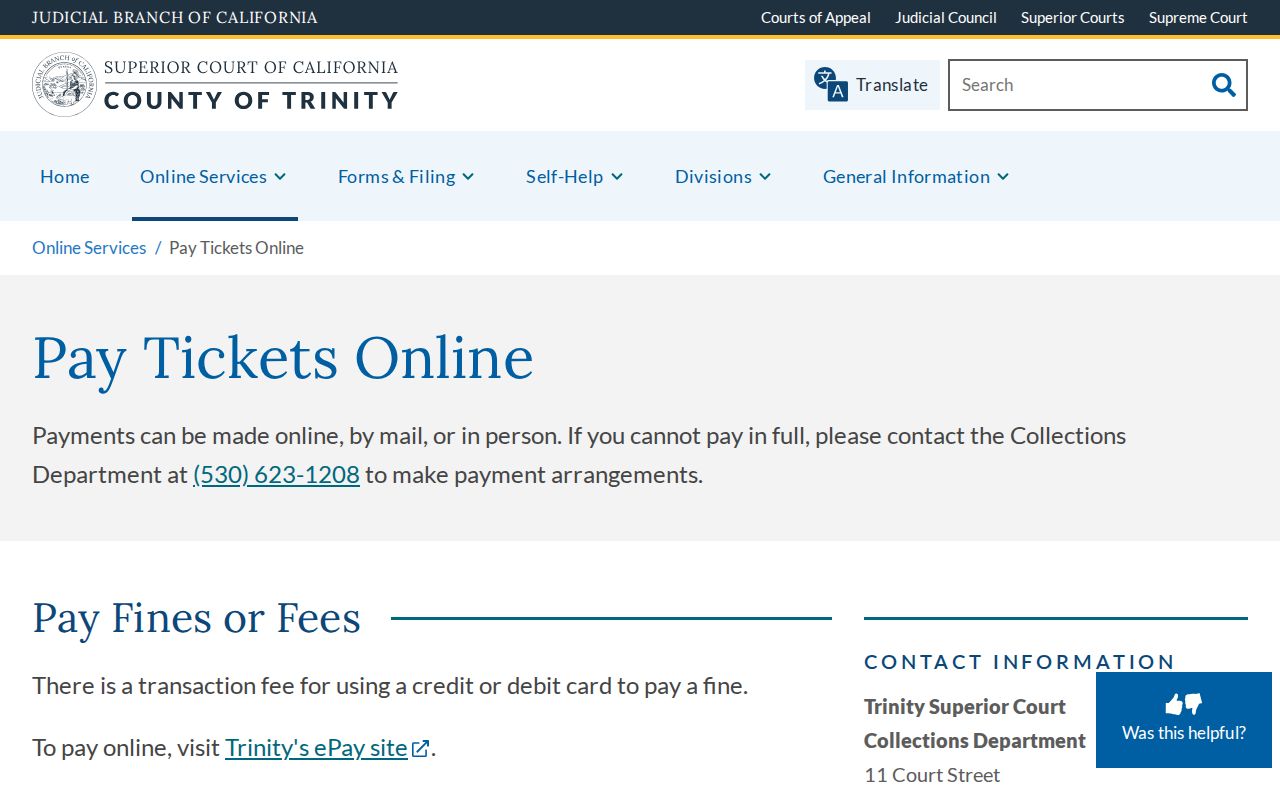
Use this route only for its stated citation and payment tasks. For a felony or misdemeanor file, return to the Trinity County Court Services request process.
Case Record Access & Restrictions
Many adult Trinity County court records are open, but public access has firm limits. Juvenile matters receive greater protection. Sealed records, victim and witness details, social security numbers, and other protected data may be withheld or redacted. A redaction removes protected material from an otherwise accessible copy. A sealed matter may not appear through ordinary public channels at all.
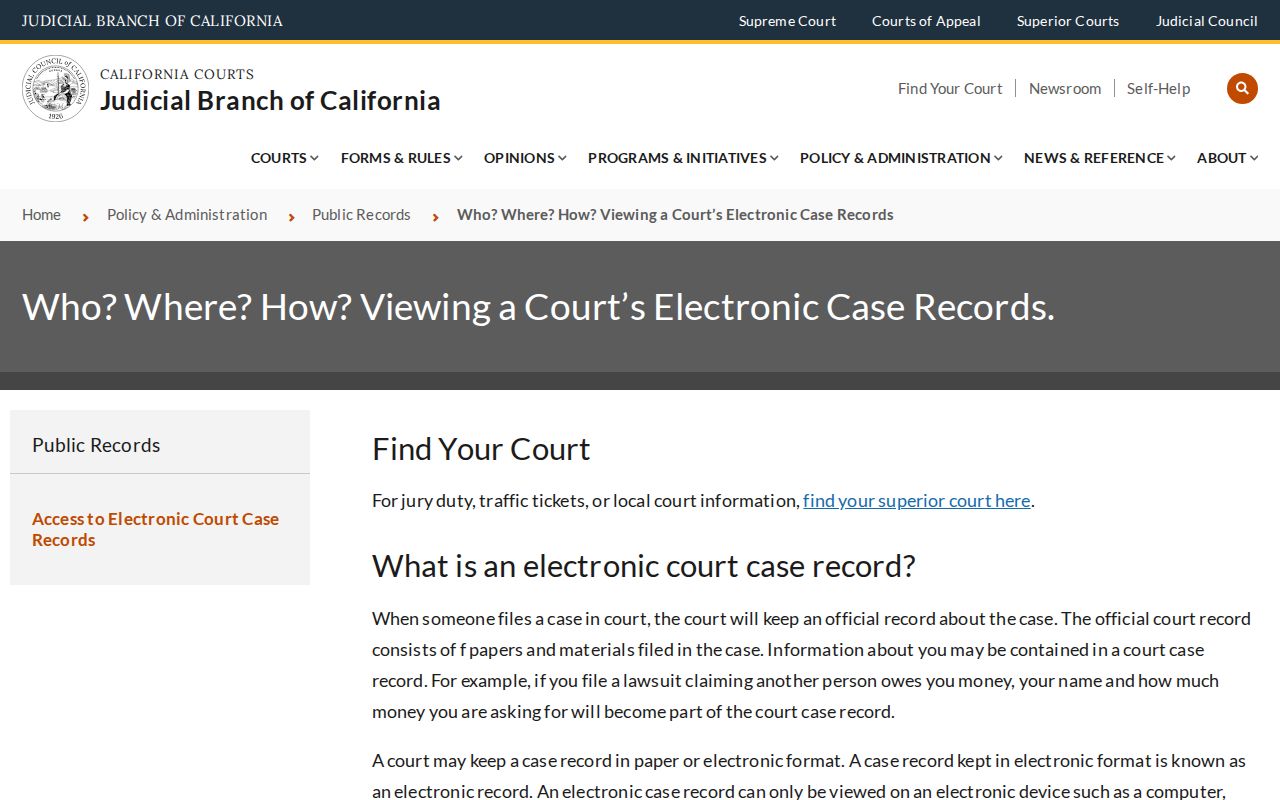
California's electronic court-record guidance explains that some case material may be viewed remotely while other material is available only at a courthouse. California Rule of Court 2.507 addresses public electronic calendars, indexes, and registers of actions. Trinity County adds a local fact to that statewide framework: its criminal files are not offered through a public online portal.
The source image from California Courts case-access guidance illustrates why the access method can depend on both the record and the court.
When a Trinity County case does not appear where expected, ask the clerk whether it is archived, sealed, juvenile, or limited to courthouse inspection. Do not assume that a missing web result means no case exists.